Arendal, Norway – 3 December 2025 – Mimeta today released its November 2025 snapshot on artistic freedom, with Memos documenting 18 censorship cases across 17 countries that reveal an increasingly global and systemic assault on creative expression.
Mimeta is a human rights organization dedicated to promoting and protecting artistic freedom of expression worldwide. Through documentation, advocacy, and strategic support, Mimeta works with partners to strengthen open, resilient, and democratic societies.
The November Report based on the Mimeta Memos on Art Censorship, Harassment, Protest & Politics
Based on the 18 Memos published by Mimeta in November 2025, this analysis identifies key patterns in how artistic freedom is being suppressed globally, who is responsible, what triggers these incidents, and what forms censorship takes.
Key Findings at a Glance
The data reveals that state actors remain the dominant force behind artistic censorship (72% of cases), while physical restrictions on freedom—including arrests, detentions, and imprisonment—constitute the most severe and common outcome (39% of cases). The geographic spread is notably global, with cases documented across all inhabited continents, suggesting artistic freedom faces systemic pressure worldwide rather than being confined to particular regions.
Who Is Censoring Artists?
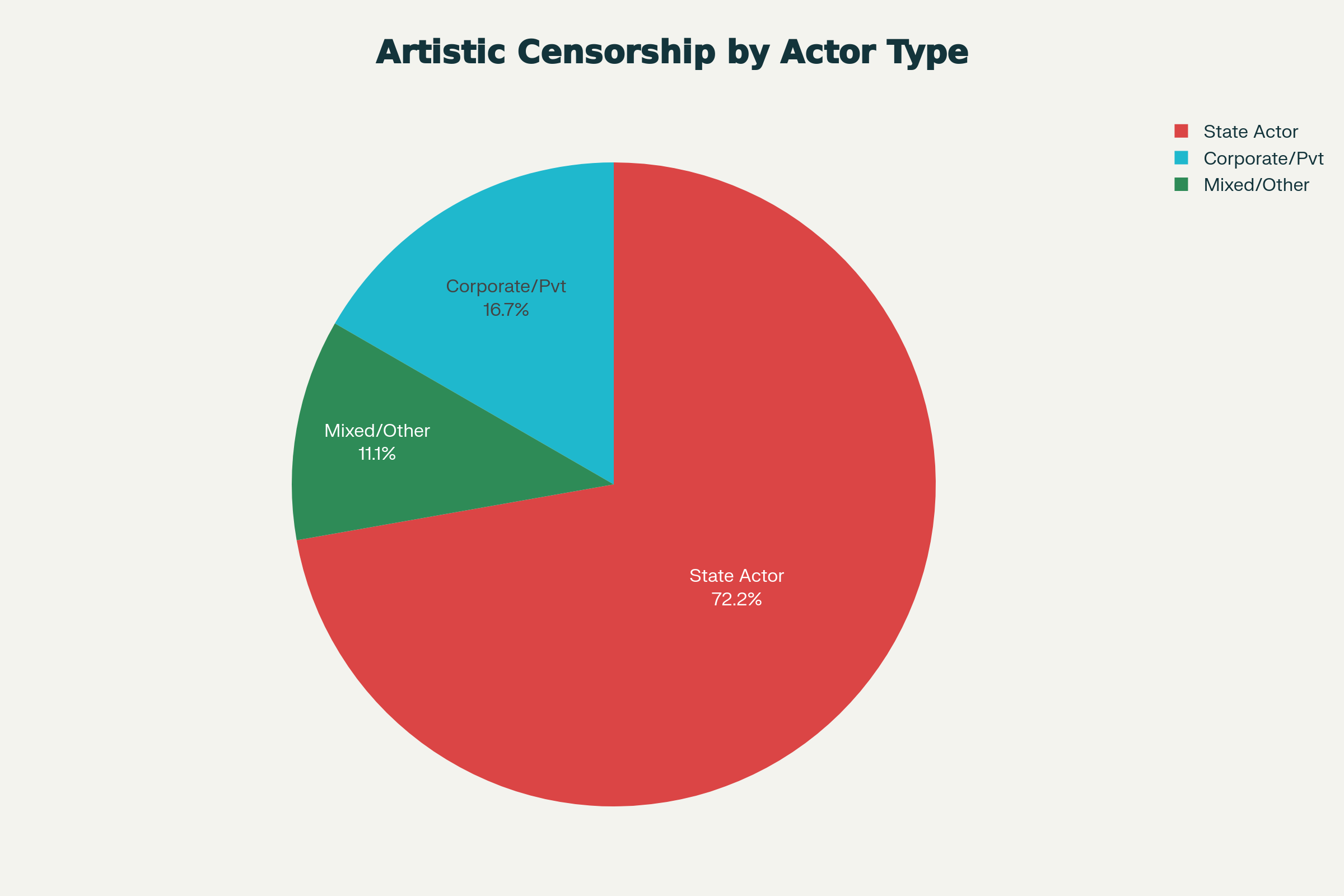
Actors Responsible for Artistic Censorship - November 2025
State actors are responsible for the overwhelming majority of censorship incidents. In 13 of 18 cases (72%), governments, state security services, courts, or police directly suppress artistic expression. This includes intelligence service arrests in Iran, police actions in Indonesia and Russia, court prosecutions in Turkey and Morocco, and legislative/administrative control in Hungary and Peru.^1
Corporate and private actors account for 3 cases (17%), primarily involving Meta's platforms. The suppression of Palestinian content through algorithmic moderation and the pulling of an anti-Meta billboard campaign in the UK illustrate how commercial interests and platform governance can function as censorship mechanisms even in democratic contexts.^1
Consequences Faced by Artists
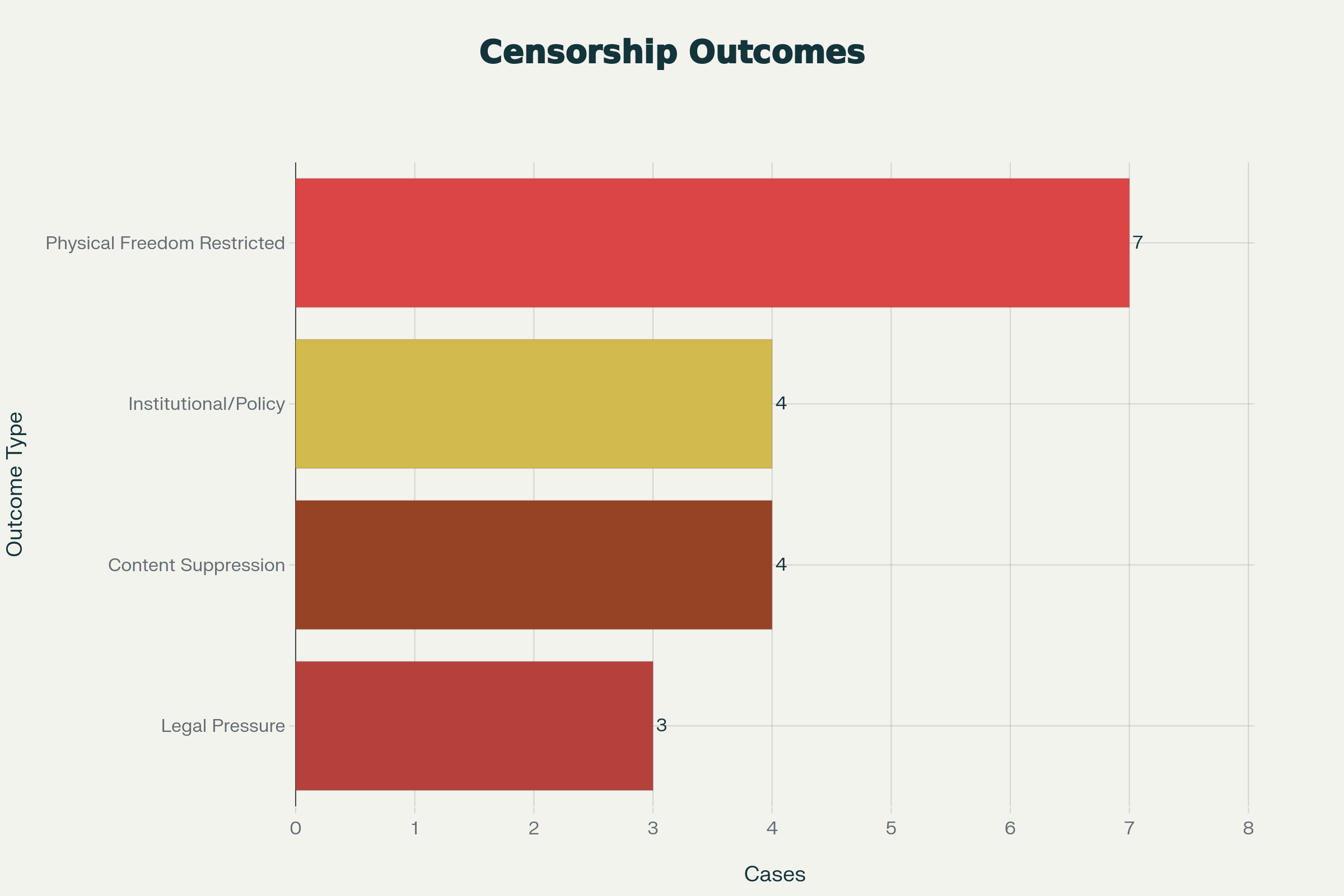
Consequences of Artistic Censorship Cases - November 2025
The most alarming pattern is the frequency with which artists face restrictions on their physical freedom:
- 7 cases (39%) resulted in arrest, detention, imprisonment, or enforced disappearance. These occurred in Bangladesh (Baul singer Maharaj Abul Sarkar), Iran (Abbas Peymani), Libya (multiple artists), Ethiopia (poet Misrak Terefe), Turkey (Çiğdem Mater), and two cases in Russia (Yekaterina Barabash and Diana Loginova's band Stoptime).^1
- 4 cases (22%) involved direct content suppression, including algorithmic removal of Palestinian content, the Malaysian music video controversy, Indonesian protest art confiscation, and the UK billboard campaign being pulled.^1
- 4 cases (22%) represent institutional or policy-level threats, including Hungary's cultural centralization, the US response to democratic backsliding, the Australia eSafety debate, and the Iraqi singer reportedly coerced into Russian military service.^1
- 3 cases (17%) involve legal pressure without immediate physical detention, including Tunisia's administrative scrutiny, Peru's chilling APCI law, and Morocco's public morals prosecution.^1
Geographic Distribution
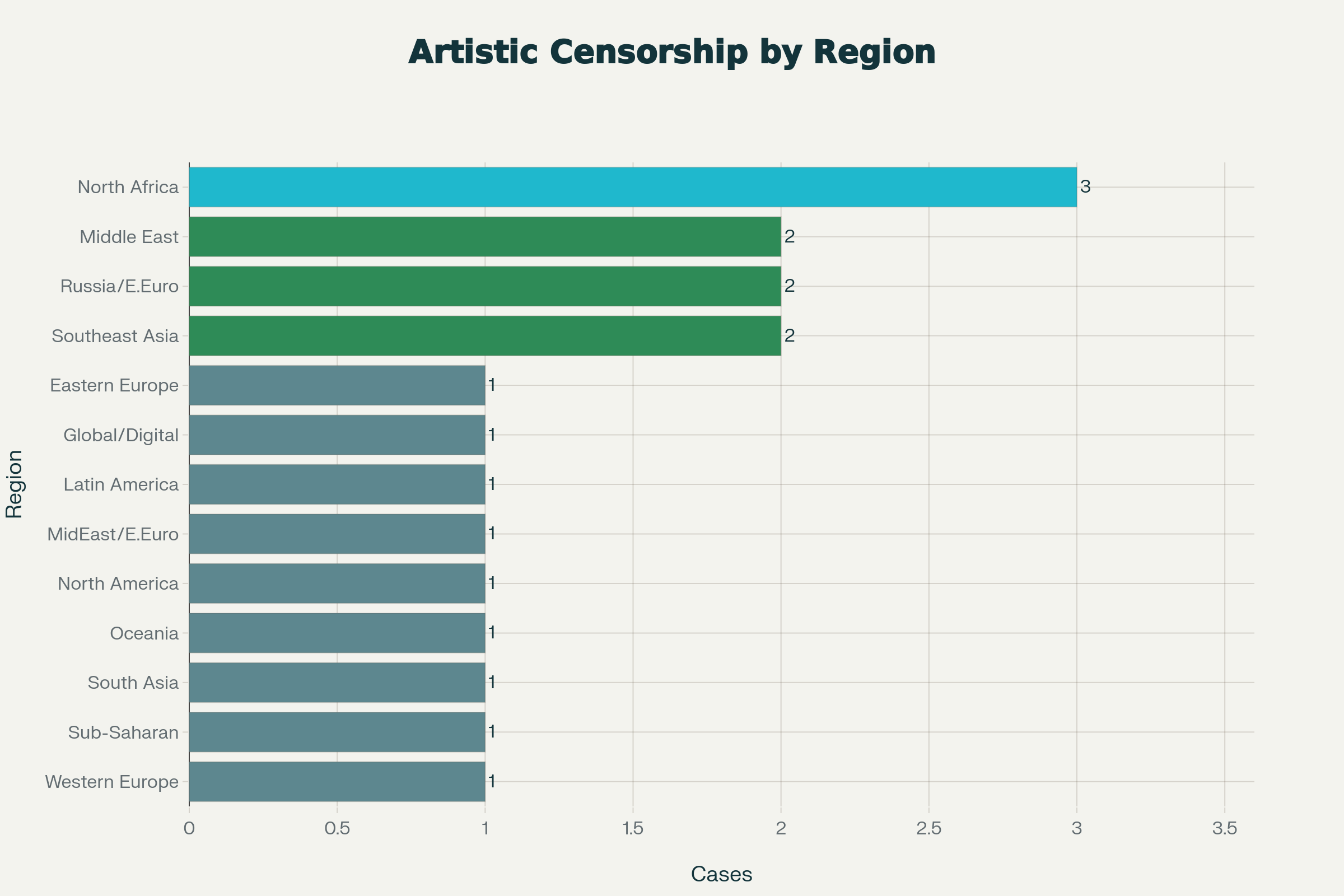
Geographic Distribution of Artistic Censorship Cases - November 2025
Cases span 17 countries across all global regions, demonstrating that artistic censorship is a worldwide phenomenon:
| Region | Cases | Countries |
|---|---|---|
| North Africa | 3 | Libya, Tunisia, Morocco |
| Middle East | 2 | Iran, Turkey |
| Russia/Eastern Europe | 2 | Russia (2 cases) |
| Southeast Asia | 2 | Indonesia, Malaysia |
| Eastern Europe | 1 | Hungary |
| South Asia | 1 | Bangladesh |
| Sub-Saharan Africa | 1 | Ethiopia |
| Latin America | 1 | Peru |
| Global/Digital | 1 | Meta platforms |
| Other | 4 | UK, US, Australia, Iraq/Russia |
The concentration in North Africa and the Middle East/Russia corridor reflects heightened state pressure in authoritarian or semi-authoritarian contexts, while cases in democratic nations (UK, US, Australia) highlight emerging threats from corporate control and regulatory overreach.
Underlying Triggers and Context
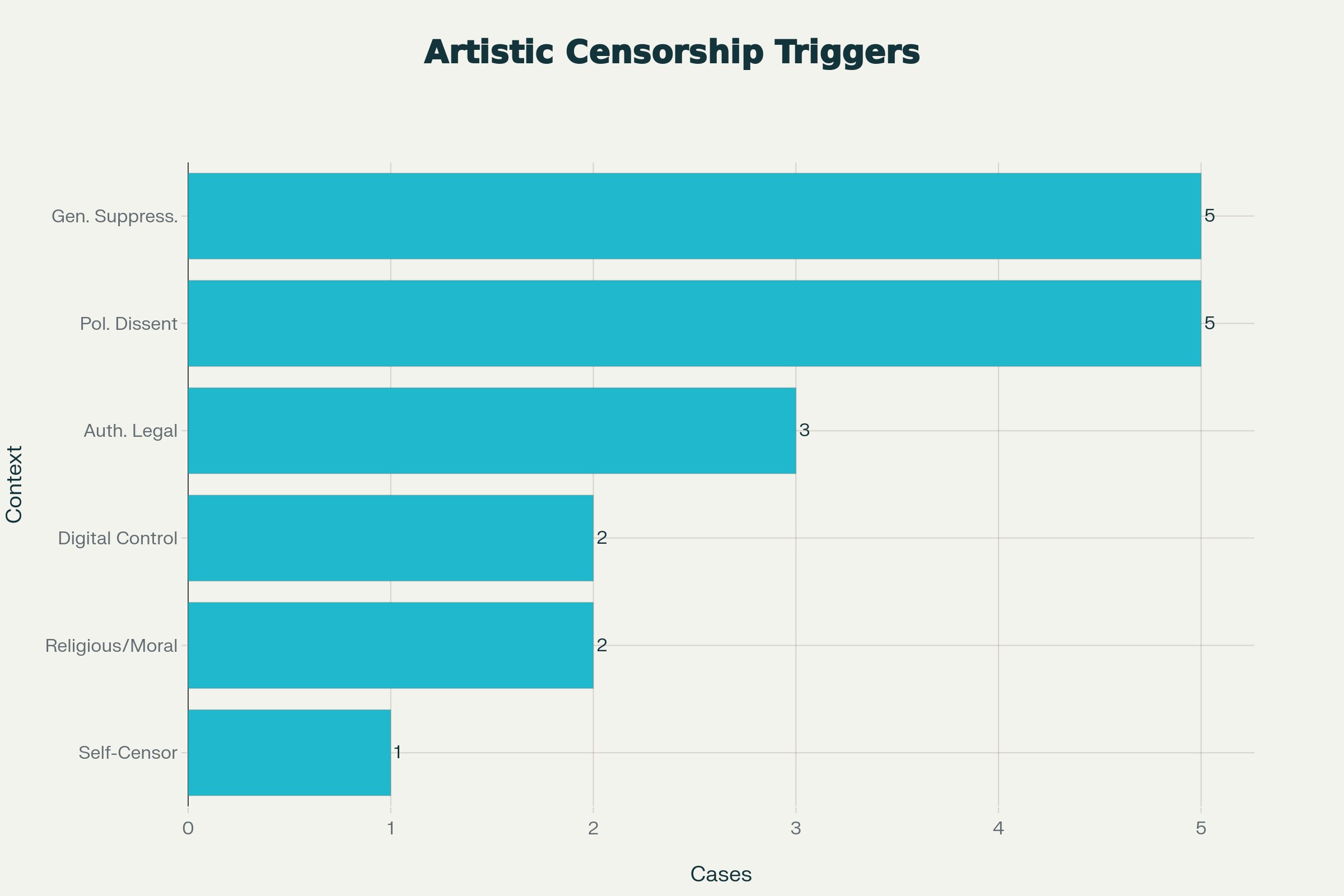
Underlying Triggers for Artistic Censorship - November 2025
Political dissent and criticism emerges as the most common trigger, directly motivating 5 cases (28%). Artists in Iran, Turkey, Russia (both cases), and Indonesia were targeted specifically for political content or anti-government expression. In Russia, both cases involved explicit anti-Kremlin artistic content—street performances of banned songs and anti-war commentary—demonstrating the particular danger for artists challenging authoritarian narratives.^1
Religious and moral values enforcement drove 2 cases (11%): the prosecution of Baul singer Maharaj Abul Sarkar in Bangladesh under blasphemy-style accusations, and the Tangier singer's prosecution under Morocco's public morals laws. These cases highlight how traditional or syncretic artistic traditions face particular vulnerability to religious establishment pressure.^1
Authoritarian legal frameworks account for 3 cases (17%), including Russia's "war-fakes" law, Hungary's legislative centralization of culture, and Peru's APCI law. These represent the institutionalization of censorship through ostensibly legal mechanisms.^1
Mechanisms of Suppression
The documented cases reveal diverse mechanisms through which censorship operates:
Legal/Legislative mechanisms (7 cases) represent the most common approach, including blasphemy laws, public morals statutes, anti-fake news legislation, and administrative regulations. This "legalization" of censorship provides state actors with formal justification while creating chilling effects beyond individual prosecutions.^1
Direct state action (6 cases) involves police raids, intelligence service operations, and administrative shutdowns without formal legal proceedings—particularly visible in Libya, Iran, Indonesia, and Ethiopia.^1
Corporate and religious authority pressure (3 cases) operates through content moderation algorithms, commercial leverage, and religious establishment influence—mechanisms that can operate with less visibility than state action.^1
Patterns by Art Form
Contemporary and popular music faces the highest risk, with 7 cases (39%) involving singers, pop musicians, street performers, and film/media creators. This likely reflects the public visibility and mass reach of popular culture.^1
Institutional and collective artistic activity—including theatres, cultural organizations, festivals, and galleries—accounts for 5 cases (28%), notably in Hungary, Libya, and Tunisia where entire cultural ecosystems face systemic pressure rather than individual targeting.^1
Traditional and folk arts appear in 3 cases (17%), including the Baul tradition in Bangladesh and traditional music in Iran, suggesting that indigenous and syncretic cultural forms face particular vulnerability to both religious and political suppression.^1
Cross-Cutting Themes
Several patterns emerge across geographic and political boundaries:
The criminalization of artistic intention: Turkey's imprisonment of Çiğdem Mater for the intention to make a documentary—a film never produced—represents an extreme but indicative trend toward preemptive censorship.^1
Platform power as de facto governance: Cases involving Meta demonstrate how private infrastructure decisions effectively regulate global artistic expression, often with limited transparency or accountability.^1
The Russia pattern: Two distinct cases from Russia, involving different artists, art forms, and circumstances, underscore the systematic nature of artistic repression under the current regime.^1
Chilling effects beyond individual cases: In Peru, Tunisia, and Hungary, the primary concern is not individual prosecutions but the broader "chilling effect" on artistic communities, creating self-censorship and risk avoidance that suppresses expression without direct enforcement.^1
This analysis demonstrates that artistic censorship cases, as of them published in November 2025, operates through multiple, often overlapping mechanisms across diverse political contexts. While state actors and legal frameworks remain the primary tools of suppression, corporate platform power and religious authority enforcement represent significant secondary vectors. The human cost—artists arrested, detained, forced to flee, or driven to self-censorship, underscores the urgent need for continued monitoring and advocacy.