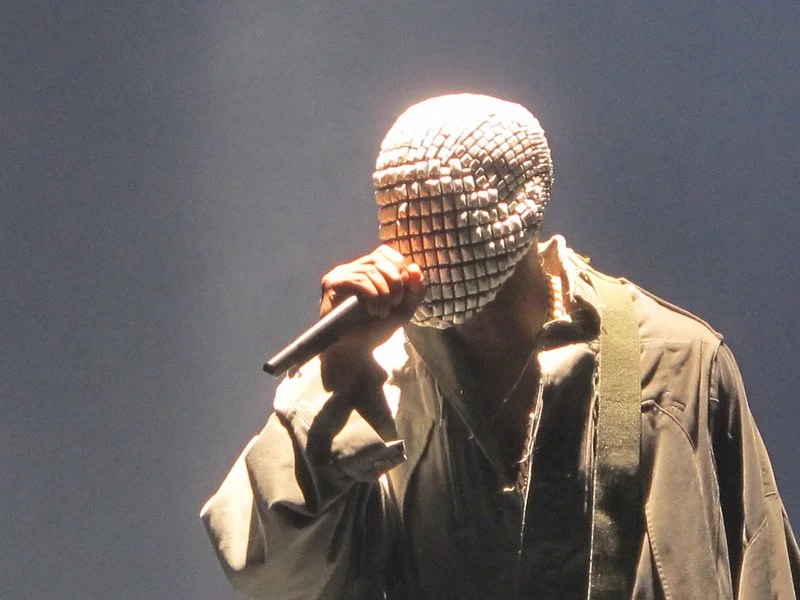
"Kanye West - Kanye Omari West" by Peter Hutchins is licensed under CC BY 2.0.
When the British authorities denied Kanye West entry and the Wireless Festival was cancelled, the move was presented as a necessary response to antisemitism and the use of Nazi imagery. The decision also marked a shift in how the state draws the line around artistic expression. The boundary was not set through legislation debated in Parliament, but through the discretionary power of immigration control.
Ye had been booked to headline three consecutive nights in London. After sustained criticism from politicians, sponsors and Jewish organisations, the Home Office withdrew his permission to enter the country. One administrative act was enough to bring down an entire festival. Other performances were cancelled, and tens of thousands of ticket-holders were affected. The reasoning did not rest on a specific and immediate threat of violence. It concerned a broader field of expression, where music, symbolism, fashion and public statements were treated as a single, unacceptable whole.
Depiction and promotion
Any serious account of freedom of expression depends on a basic distinction between depiction and promotion. Art can present fascism, racism and violence in order to criticise, to examine or simply to reflect what exists. Promotion carries a different meaning. It involves endorsement, glorification or incitement. Democratic societies have long accepted that art may depict what they seek to resist, while the law intervenes against direct encouragement of violence or persecution.
Ye’s public conduct places pressure on this distinction. His statements have moved beyond ambiguity and into open engagement with antisemitic and pro-Nazi rhetoric. Yet the justification for the entry ban did not separate specific statements from the wider body of work. Music, fashion, interviews and online posts were treated as a unified risk. The focus shifted from identifiable acts to the person as such.
Administrative judgement
The method matters as much as the conclusion. A system grounded in the rule of law would begin with identifiable expressions, assess them under general legal standards and, where necessary, impose conditions on particular events. Restrictions on content or security arrangements can be tailored to the circumstances. Exclusion from the country or the cancellation of an event would follow only if a serious and unmanageable risk remained.
In this case, the United Kingdom relied on a broad provision that entry must serve the public good. The decision was taken within a government department rather than tested in open court. The grounds were not tied to a specific performance or a defined set of statements. Public visibility was limited, and the scope for independent scrutiny was correspondingly weak. Media pressure and commercial concerns formed part of the background against which the judgement was made.
A real problem, an uncertain response
The wider context is not in dispute. Jewish communities across Europe face increasing hostility and threats. The state has a clear duty to protect them and to prevent incitement to violence. The question is how such protection is best secured in practice.
An entry ban can have effects that run beyond the immediate case. It may strengthen the artist’s claim to persecution and reinforce the idea that dissenting voices are suppressed by institutional power. Audiences may move towards smaller and less regulated arenas. Other states can point to the decision when they refuse entry to artists who criticise their own governments or represent minority positions.
Another approach
A different course is available within existing legal frameworks. Authorities can examine planned performances in detail. A song that explicitly glorifies Nazi violence, a stage design that functions as propaganda, or spoken passages that incite hostility can be assessed against established thresholds for hate speech and public order. Where those thresholds are crossed, organisers can be required to make changes. Refusal to comply would bring the matter into sharper focus and could justify stronger intervention.
This approach directs attention to conduct rather than identity. It keeps decisions within a framework that can be examined and challenged. It also preserves space for artistic work that is difficult, unsettling or offensive without crossing into unlawful promotion.
At the edge of tolerance
The case of Ye places pressure on institutions that are used to clearer distinctions. It tests how far a society is willing to separate objectionable ideas from the conditions under which they may be expressed. The stage in London remains empty. The audience has dispersed. The line that was drawn lies not in the music itself, but at the border control desk.
References:
When British authorities denied Kanye West (Ye) entry to the UK, the immediate consequence was the cancellation of Wireless Festival and the disruption of tens of thousands of ticket holders. But the deeper issue goes beyond one event or one artist.
The decision was taken through immigration powers, not through parliamentary legislation or tested in open court. It was justified on broad “public good” grounds in the context of allegations of antisemitism and Nazi imagery linked to Ye’s public statements and symbolism.
A key tension sits in the distinction between depiction and promotion. Democratic societies generally allow art to depict offensive or extremist ideas in order to critique or reflect reality, while intervening when there is direct incitement or glorification of violence. In this case, that boundary becomes less clear when music, fashion, performance and public speech are treated as a single unified risk.
The challenge for liberal democracies is not whether to respond to harmful speech, but how to do so in a way that remains transparent, proportionate, and legally grounded.
#FreeSpeech #ArtAndPolitics #Censorship #UKPolitics #KanyeWest #Ye #MusicIndustry #HumanRights #CulturalPolicy
The Economist: «Failing the Kanye test – The American rapper drags every British anxiety into the open», 8. april 2026.
BBC News: «Wireless Festival cancelled after Kanye West blocked from coming to UK», 7. april 2026.
The Guardian: «Home Office bans Kanye West from entering UK», 7. april 2026.
The Conversation, Mark Elliott: «Kanye West banned from UK: legal expert explains why», 8. februar 2026.
Al Jazeera: «UK blocks rapper Kanye West from entry over anti-Semitism and Nazi support», 7. april 2026.
People Magazine: «Wireless Festival Canceled After Kanye West's Travel Blocked by U.K.», 7. april 2026.
Wireless Festival: «As a result of the Home Office denying YE entry into the United Kingdom, Wireless Festival is cancelled», april 2026.
Sky News (TV-innslag): «Kanye West blocked from travelling to UK», 7. april 2026.
BBC Global News Podcast: Segment om innreiseforbud og Wireless-avlysning, 7. april 2026.
Firstpost: «Why the Wireless Festival 2026 has been cancelled», 7. april 2026.