The sudden cancellation of Malek Jandali’s “Syrian Symphony for Peace” tour in December 2025 has exposed how cultural policy, religious authority and the politics of martyrdom intersect in post war Syria. The decision to drop his Homs Clock Square concert at the last minute, followed by conflicting official and religious justifications, reveals how fragile guarantees remain for artists using public space to confront traumatic memory.
Iraqi singer Mohammed Abdel Jabbar successfully performed in Nasiriyah on November 15, 2025, despite opposition from religious figures who condemned the concert as incompatible with the city's religious identity. However, just over a week later, concerts scheduled in Basra were cancelled after the organizing company received threats. The cancellation followed protests by clerics denouncing entertainment events, continuing a pattern of pressure against cultural activities in southern Iraq since 2019.
Posted
UK-based Syrian comedian and journalist Malath Alzoubi faced a wave of online threats after a July 2025 stand-up clip satirising Syria’s new leader Ahmad Al‑Sharaa and HTS’s history of dismantling infrastructure. Weeks after the video, a coordinated harassment campaign across Instagram, X and Facebook used homophobic slurs and location-based threats, exposing how Syrian artists in exile remain vulnerable to transnational digital intimidation.
Iraq’s 2025 Husseini Chant Festival shows how religious authority can curb cultural policy without legal bans. After the Ministry of Culture introduced instrumental music into Arbaeen rituals, a clerical backlash led by Ali Al‑Talqani sparked online outrage and institutional hesitation, revealing how informal pressure and fear of controversy drive self‑censorship in Iraq’s cultural sector.
Posted
CommentPost a comment
In May 2025, a governance crisis shook the Syrian Artists’ Syndicate when four council members challenged newly appointed head Mazen Al‑Natour over unilateral decisions and lack of accountability. Their attempt to withdraw confidence was rejected as “illegal,” followed by their removal from the council. The episode exposes how post‑Assad institutions risk replicating old authoritarian patterns instead of protecting artistic freedom
In January 2026, Adelaide Writers’ Week imploded after its board disinvited Palestinian‑Australian author Randa Abdel‑Fattah in the wake of the Bondi Beach Hanukkah shooting. Abdel‑Fattah called the move “a despicable attempt to associate me with the Bondi massacre,” arguing that her mere presence as a Palestinian was treated as dangerous or “unsafe,” sparking a mass author boycott and institutional crisis.
Myanmar’s artists, musicians and performers have become voices in resisting the junta’s rule, both inside the country and in exile. Through satire, underground music scenes and documentary projects, they document abuses, support mutual‑aid networks and challenge propaganda. Despite arrests, executions, citizenship revocations and harsh new laws, these creative communities continue to carve out rare spaces for honest expression and solidarity.
Indian films are facing growing, selective scrutiny in Gulf states, especially when they depict India–Pakistan tensions, Kashmir, or LGBTQIA+ lives. Recent bans on “Dhurandhar”, “Sky Force”, and the Malayalam film “Maranamass” show how geopolitical sensitivities and moral norms shape access to cinema for South Asian audiences across the region
Egyptian authorities are widening their morality crackdown to TikTok and other short video platforms, using vague charges of indecency and violating family values to detain comedians, belly dancers and youth creators. The arrests of high visibility figures like Mohamed Abdelaty show how digital platforms have become a new front line for tightening control over artistic and everyday expression in Egypt.
In November 2025, the Bern Light Show in Switzerland removed Tibetan works, including Tenzin Mingyur Paldron’s film “Listen to Indigenous People”, after pressure from Chinese authorities. Framed as “too political” for the Federal Palace façade, the decision exposes how cross border censorship and institutional self censorship can silence exiled communities, even inside Europe’s supposedly safe democratic spaces.
FEATURE: Russia is rapidly constructing a new censorship machine that reaches into every field of art. Renowned filmmakers like Alexander Sokurov are rebuked in front of Putin, publishers face extremism charges over LGBT‑themed books, theatre directors are jailed for “justifying terrorism,” and musicians, museums and street artists navigate raids, blacklists and vigilante denunciations. Together, these cases reveal a deliberate strategy to turn artistic life into a zone of permanent legal risk.
Kazakhstan is tightening legal pressure on artists, comedians and satirists, using “petty hooliganism,” “incitement of hatred” and new “LGBTI propaganda” provisions to police creative work. Recent cases against a rapper, stand‑up comics, a choreographer and a satirical blogger have turned social media into an early‑warning system, as artists frame each arrest as part of a broader crackdown.
Nigeria: Over the past year, Kano State's Film and Video Censorship Board has emerged as one of West Africa's most assertive cultural regulators. In May 2025, it suspended 22 popular Hausa-language drama series including Labarina and Dadin Kowa, barring all broadcast and streaming. The Board also banned singer Usman "Sojaboy" and actresses Shamsiyya Muhammad and Samha Inuwa on moral grounds, while closing eight entertainment centres and restricting Islamic musical debates. These actions reveal how sub-national authorities reshape artistic ecosystems through enforcement of Sharia-aligned cultural policy—while clashing with Nigeria's federal broadcasting regulator.
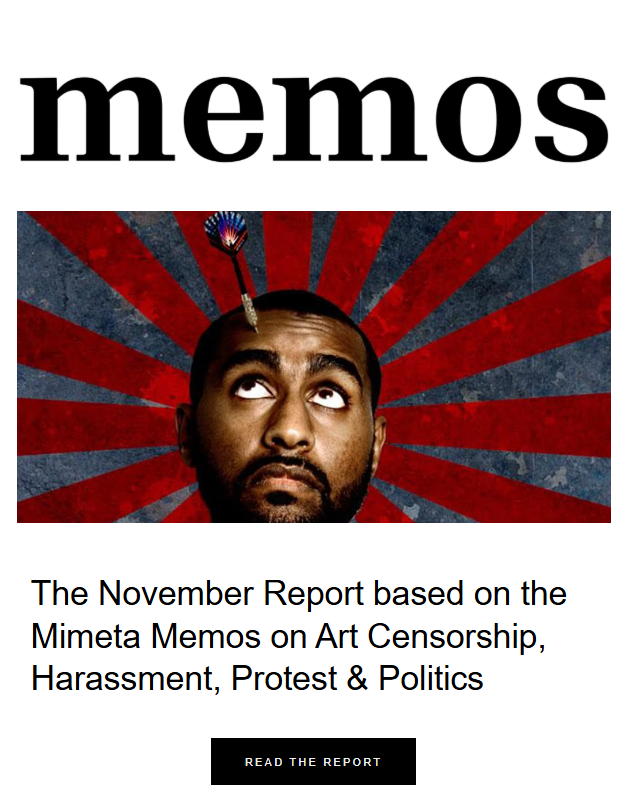
Mimeta’s December 2025 reporting focuses on the Middle East and North Africa, revealing how artistic life is increasingly constrained by overlapping systems of state power, religious authority and informal enforcement. From disappearances and arrests to quiet bans and moral campaigns, artists across the region face repression that is often unwritten yet deeply effective, shaping what can be seen, heard and performed, and who is allowed to appear in public cultural life.
Posted
CategoriesCensorship in Arts, Censorship MENA, Censorship SWANA, Middle East, Mimeta, North-Africa, Reports
Israeli intelligence forces raided Jerusalem’s Palestinian National Theatre, Al-Hakawati, during the children’s musical “Dreams Under the Olive Trees,” ordering families to evacuate within five minutes. The shutdown of a licensed, internationally funded cultural event has drawn condemnation from theatre groups, human-rights advocates and media outlets, who say it exemplifies the broader repression of Palestinian cultural life and children’s rights in Jerusalem.
When Syria’s pioneering stand‑up collective Styria cancelled its shows in Hama during the country’s first Comedy Festival, co‑founder Malke Mardinali warned that “every word is being scrutinized and reports are being filed.” The incident captures how surveillance, informal pressure, and fear of denunciation still define the limits of artistic expression in Syria’s fragile post‑war cultural opening
In August 2024, Egyptian syndicates suspended Lebanese singer Haifa Wehbe’s work permits over contractual disputes, briefly restoring them later that month. In March 2025, the Musicians’ Syndicate escalated the case by banning her from performing, after a complaint from her former manager. The Administrative Court finally overturned the ban in December 2025, closing a 16‑month battle with major implications for artistic freedom
Kurdish violinist Nima Mandoumi, 23, was seized by Iranian intelligence in Alborz province on 9 December 2025 and has since disappeared into incommunicado detention. His arrest reportedly followed an international concert in Armenia involving Israeli musicians, underscoring how Iran’s security apparatus is criminalising cross‑border artistic collaboration and using enforced disappearance to silence Kurdish cultural voices
After months of religious backlash, boycott calls and a high‑profile lawsuit led by lawyer Mortada Mansour, Egypt’s Supreme Administrative Court upheld the right to screen the already‑licensed feature The Atheist, reinforcing constitutional protections for artistic creativity and limiting attempts by private actors to erase controversial works from public space.
When Pomme d’amour, a satirical short film by Fares Naanaa, was re-released online in 2025, it ignited a wave of outrage over alleged blasphemy. Yet behind the public uproar lay a deeper story , one of political distraction, fear-driven self-censorship, and the rapid erosion of Tunisia’s post-revolutionary creative freedoms.